For some people who don’t know, how would you describe what you do?
I’m a performer at the Renaissance Festival, and I’m a musician, and what I play is called the glass harmonica, and it’s, it’s a brand of wine glasses that are water tuned, and I make music.
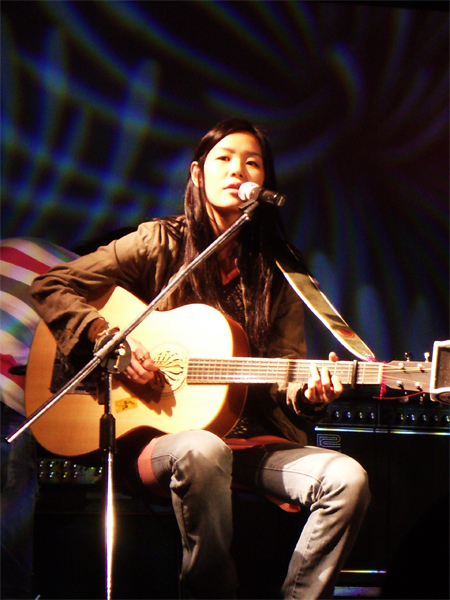
It’s a very old art form that I learned from my big brother, believe it or not. So that’s what I do. And also perform on the guitar. However I I broke my finger about three weeks ago. I can play the glasses because my fingers stay straight. The guitar I can’t.
Yeah, cause your fingers curl, right?
Yeah.
So I also perform the guitar, but I think you’re probably interested in [glass harmonicas] more than anything else. So
So it’s glasses, right? How do you source your glasses? Like, do you go to thrift stores or, like.
You got me! That’s exactly what I do. I always said that’s part of my show when I talk about the fact that when you, when you do this, when you want to make a sound on a glass, it doesn’t have to be crystal glass or anything fancy.
Yeah.
That I get all my my glasses at thrift stores, flea markets, garage sales, and it just requires a stem. You don’t have to have anything fancy.
How do you, like, inspect them? Like, how do you determine, like, I want to buy this one for.
You know, it’s, I’m embarrassed to say it’s not, it’s not very, it’s probably not very hygienic. But I’ll go to a Goodwill or Salvation Army or whatever I see a glass I like.
I’ll kind of look around and super works, you know. And people think it’s funny, because people think I’m checking to see if it’s crystal. There’s a there’s a there’s a common misconception that only crystal works, and people think I’m checking to see if the glass is worth more than it should be, or whatever.
I’m just looking for notes so and I look for, so I look for things that’ll fit in that general size range, because you want to have something fairly uniform.
Yeah.
But you know, a lot of glass players will have their glasses made for them.
So they’re a little bit more very uniform. And I like this because it’s every glass has a story.
Yeah, what’s your favorite story about the glasses?
A favorite story about the glasses? Wow, about performing the glasses. Or, let’s see. Oh, either one, you know, it’s hard, too hard to pick one. I’ll tell you. I’ll tell you what, what I like about doing this and my favorite times, or, as the way, mostly the way kids react when they see something that they’ve never seen before.
And I’ve been doing this for, gosh, 35 years, and I’ve seen how, how attention spans, and things have kind of gotten a little less, and I still have people that walk by a lot of festivals I play in the streets. I’m a street performer.
Yeah? Here I have a stage show, but I’ll play in the streets. And I’ll see families walk by, and some of the elders, like the older kids, or maybe even the parents, are interested, but the kids have them looking at the phone, yeah? Oh, I’ve seen that before. I’ve seen that before. Visit, but it’s live. It’s right here, it’s in person. So, so, but, but over the years, I think it’s, it’s the way the kids react when they see what’s happening, yeah, and let, let them try it. I teach them how to do it.
Just disseminating the information, because it’s, it’s a very science-based thing, but it’s also a little magic in there, because it’s a cool instrument. That’s, I don’t have any one particular story, I would say that’s my favorite.
Okay, so you’ve, you’ve covered “Strawberry Fields Forever” by The Beatles, right?
Yeah, yes.
Have you ever covered any other Beatles songs? Or
Sure, I could do, I could do a couple. What’s the one? Do-do-do
Hey, Jude.
You know, when some of the things I do sometimes in the streets is I’ll play stump the glass player, and I play by ear. And I’ll play Stump the Glass Player. And so what I’ll ask people to ask re requests, and I play by ear.
So if I know the song, if I heard it, it’s I’ve got the melody, I can usually pick it out. Play like all the Pink Floyd and Beatles. So I do a lot of stuff like that, but “Strawberry Fields Forever”. I worked up because of the intro.
Yeah.
Yeah, totally. So.
What would you say is, like, the weirdest song you ever performed?
Weirdest song, okay, probably Zelda, The Legend of Zelda, and it’s because I’m not a I’m not a gamer.
I mean, gaming for me was like Space Invaders, yeah, so our Pong. But I realized what a cultural phenomenon Zelda was in particular.
I mean, you probably already have seen a couple of them, and for years, people would ask for that song. And I had a guy that would come every year at this festival in Oklahoma, and he’d have a 20 bucks, $20 bill in his hand.
He’d say, “This is going in your jar, if you can play Zelda”.
And I say, “I don’t know” way back. And then he actually just got fed up with me, and he sent me the MP3 of the Legend of Zelda.
And I listened to that song, and I go, that’s, that’s weird, but I could see how engaging, how it’s just looped over and over. And then when I learned how to play it, I went, “This is actually a very, very cool song”
I’m not pronouncing this, right? Probably Ghibli. Is it? Ghibli, the Ghibli? Is it okay? Studio, Ghibli. Those songs have been a revelation to me. Is it last is it? Last year, I was contracted to play a wedding here at Scarborough Fair, and the bride and groom wanted the merry-go-round of life from Howl’s Moving Castle.
And I said, Sure, sure, no problem. I can. I had no idea what it was, so I looked it up, and I said, Oh, because it was pretty complex. And I, I don’t have, this is not what you’ll probably learn at the show. But this is not a chromatic scale. This is, this is a diatonic, and so sometimes I don’t have all the notes that I need. I had to add a, actually add a glass for that song.
But I was in the process of learning that I really fell in love with that music. And that’s looking at all the other stuff.
Is it Joe Agyashi that I’m not pronouncing right either? Yeah, yeah, it’s Joe something. Hi, it’s a he’s a Japanese composer, and all just wonderful music. I’ve worked up a couple of other ones. Anyway.
Well, what’s your favorite song, personally, that you played?
Depends on which day you ask me, I guess, probably an old Irish tune. It’s called she began shamor. And it’s a, it’s a, it’s in, it’s a, it’s in a key that don’t often play. And it’s a key of C, and it has a resonance to it, and says it’s about a 400-year-old tune.
It’s just got a little magic to it. And I just, I like, I like the melody and like playing that song. It’s called “Sheebeg and Sheemore”.
She’s S, H E, E, B, E, G, and then S, H, E, M, O, R, E, that’s, that’s Irish, that’s Gaelic for big hill, little hill. It’s about a fairy.
Are you gonna play it today?
I’ll play. Yeah, for sure.
Okay.
This is art that takes a form, back to the Mozart era. Does it feel like a new, elegant niche, or does it feel like a new audience, apart from the kids you mentioned earlier?
It’s a good question. I think it’s always going to be kind of a niche thing. I’m working on ways, the way I approach, in fact, I was just talking to someone after my first show, but the way I approach this, you can see players in Europe, there are a lot more players in Europe than there are in America. If you go online, you’ll see people do really flashy, amazing things that I can’t.
What I’m really about is, is making melodic, nice, legitimate music. I think a lot of people still look at this as a parlor trick, yeah, a bar trick or whatever. And I’m trying to take it out of that into a bona fide instrument, and that’s what, that’s what Ben Franklin did many, many years ago. Made this. He made a glass instrument based on one that Mozart composed for. And I think that brought it into more legitimacy.
But the thing about that one is it’s really amazing. This is a little bit more varied, and I don’t know it. I think one, the one way I think it can become even more legitimate, legitimate in the eyes of people, is when it’s combined with other instruments. And I love playing with other people. Yeah, I’ve been playing for a number of years at this festival. There was a band called Cantiga comprised of a master harp player, a master fiddle player, of the gamba, which is closer to this cello, and me, and I became like a keyboard player.
I’m not back here doing these chords, and they disappear with the violin. It’s a wonderful, wonderful experience. In fact, I can, I can give you one of my drives that has that, that music on. It’s, it’s, we actually recorded live here one time. Anyway, I think, I think when you combine it without, I’m thinking about putting together a little, a little quartet.
Okay, what’s your dream quartet?
It would be that, I think that configuration, it’s amazing how well all those instruments, the violin, the violin in particular, one of the names for this instrument is the ghost fiddle.
Really?
It’s a great name. Someone at that concert we did. I’ll start a line, and Thomas the file in player would start something, and then we would sort of, and then you couldn’t tell which was which, after a while. And then the Harp was very percussive. And this is kind of a percussive instrument too, but the Harp was kind of driving it. I like, I like that configuration, harp, glass, cello, violin. I live in Nashville, so I should be able to put that to use.
Has anyone come up to you? You’re like, I want to learn this instrument.
Yeah, yeah. And part of my show is to, is to basically explain to people how, how might give them tips on how to, first, to make the sound, and then how I put this instrument together. And it’s really just a matter of stick-to-itiveness or just diligence. You just have to go out and, you know, scour the thrift stores. It took me quite a while to gather enough together and then actually put the scale together.
Yeah.
And that, that, in essence, teaches you how to play in itself.
So, still on the music note, what do you like about the guitar right away?
Oh, the guitar is, it’s always been my vehicle for writing. I’m a songwriter, yeah, and all of my, all of my inspirations were singer-songwriters.
When I was growing up, there was a great singer-songwriter in Texas who never made a national name, but he wrote songs for people like Willie Nelson. His name was Steven Fromholtz, and when I was about 14 or 15, maybe, yeah, somewhere around there, my big brother stuck me into a bar on Greenville Avenue in Dallas, and saw him, and saw what he did, which he told stories and played these amazing songs that he wrote.
I thought that’s what I want to do, and so that’s, that’s why I’m in Nashville. I’m pursuing what I’ve been doing. I’ve made a little bit of a name for myself in folk radio and alternative circles. It’s more folk stuff, but it’s, it’s the guitar. Is my, is my, my first love. And it’s really for songwriting, yeah. But I could post some things on this as well.
Yeah, do you later kind of explain how you go about tuning it?
I do. I do. That’s part of the show. Yeah, I try to keep it around 2530 minutes. So yeah, talk about how the great story about how I became a glass player as well, about my brother, will be a tribute to him, and how you tune it to the history. It’s got a nice history behind it. So I try to, my whole goal is to keep people in my show.
Yeah, I was always a street performer and, and when you’re doing that, you are, you’re performing for people in short bursts, and people stop for a couple of songs or whatever, and you may explain something, but for a show, you know, you realize that some people, maybe may think it’s really, really cool for a song or two, and then you want to move on.
So I try to, I try to, my whole goal is to, is to impart this information and keep them interested and keep them here, so, and it’s been going well, I think I’d better get this stage. Let’s see, we got oh, we’re good, we’re good, but I appreciate it.
My pleasure, guys.