Hi, I’m Olivia, and today, I’m here with…
Sarah Mullen.
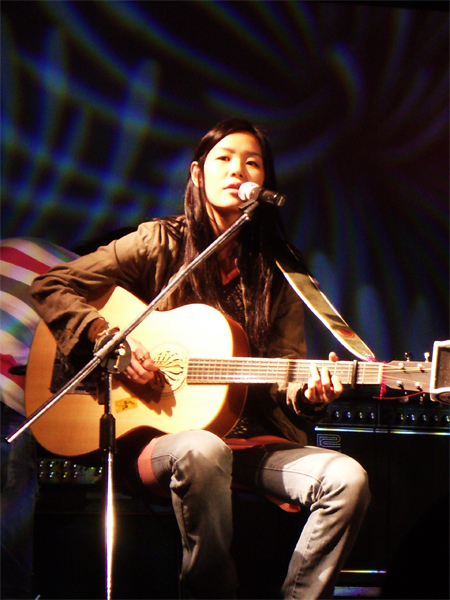
And you are a harpist at Scarborough Faire. First question—I feel like obvious question—is, how long have you been playing harp?
Thirty-five years.
Thirty-five years, okay. You don’t look like you’re old enough to have been playing harp for thirty-five years.
Thank you very much.
How long have you been playing at Scarborough, specifically?
I believe this is my twentieth season.
Twentieth season, okay. We just spoke to Rita with the hammered dulcimer, who’s also season twenty, she said.
Mhm, yeah, I think we did start around the same time.
That’s so cool. Is Scarborough your main event that you do, or?
I work these events all over the country. So, this is one of five renaissance festivals I’m set to appear at this year.
Wow, so you do a lot of travelling around then?
Mhm, yes.
What are the other faires that you go to?
So, I just came here from the Arizona Renaissance Festival. After this show, I’m gonna go to the Colorado Renaissance Festival. From there, to the Pittsburgh Renaissance Festival, and then my season ends at the Carolina Renaissance Festival, which runs October-November.
That’s pretty much a full year. What do you do in your off-season?
Well, December usually gets taken up by holiday gigs, and January is when we do everything else in our lives. If we take a vacation … it’s January. When we work on albums and recording work, also January.
When you say ‘we,’ is that you and your….
My husband and I have two kids as well.
Wonderful. Does your husband play at the faire?
He does work at these festivals—he is a musician, but he doesn’t perform at ren faires. So, he runs the sky chairs booth down the lane. So, that’s his booth.
Are your kids running around as well?
There’s Teacher Jenny. She runs a child care program for the people who work here.
I love that.
So, they’re with Jenny. They’re having a great time.
That’s great. Do all ren fests have something like that?
Not necessarily. Some faires, you just have to figure out your own childcare. And some people do—I mean, Jenny isn’t employed by the festival, so we pay her.
Gotcha.
But, she sets up here every year. She has a whole building backstage.
Oh, wow.
Some other faires, we bring a baby sitter over to our RV.
What drew you to ren faires with the harp?
Honestly, I just fell into it. When I was in high school, I was performing for some arts event in my hometown in New Jersey, and somebody from a faire that doesn’t even exist anymore, the New Jersey Renaissance Kingdom, saw me performing there and said, “Oh, you should come work our event. It’s starting in a few months.” It was my senior year of high school. I had some time before I had to go off to college, so I was like, “Yeah! Sure, that sounds like a fun thing to do.” I’d never heard of ren faires. Never stepped foot on one before the first day I worked at one.
Wow. What was that first day like for you?
I mean, it was a learning experience, but I had a lot of repertoire already. I’d been playing the Celtic harp for many years at that point, so I had a lot of repertoire. I quickly found other musicians; we knew tunes in common…. I just fell in with a group of experienced musicians at the faire pretty much from minute one. Some of them are still friends of mine.
That’s brilliant. So you’ve been playing here for twenty seasons. All-in-all, how long has it been that you’ve been traveling around the country, playing at different faires?
My first year on the road was 2004.
Wow.
So, I never thought of festivals like this as a way that I was gonna make a living. […] When I first did it, it was a “fun thing to do” on my summer break from school. But then, in 2004, I had moved, I had left my job, I was looking for something different to do. I was working in a laboratory and I was feeling kind of burned out on doing animal research, so I wanted to do something very, very different. I had a harp, I had a costume, and I saw that the Carolina Renaissance Festival was opening in a week, and I just sort of believed my way in.
That’s amazing.
And then they sort of immediately went, “Oh! We have another faire, the Arizona Renaissance Festival. We would love it if you would come out and perform there.” It never really occurred to me before then to travel and do this, but they asked me to, and I wasn’t doing anything else, so I said, “Sure!” And then, the next faire asked me if I would come, and then I started talking to the people who do this full-time, putting together a circuit, sending out my promo materials, and the next thing you knew, I was booked for a whole season.
That’s amazing. Do you have a lot of people who appear at the same faires then?
Oh yeah, there’s a lot of people that I see at multiple faires that I work throughout the year.
That must be great. [Are] faires how you met your husband?
Yes! Actually, you know what? We met right over there. (points)
No way!
See the start of that bridge over there?
Yeah?
That’s where we met.
Oh, that’s wonderful. Was it just a bumping into each other? Was he working the faire?
He was working, and I was working, and normally, because of where he worked and where I worked, we wouldn’t have run into each other. He had been sent home early because he was sick. He had started running a fever in the middle of the faire day, and his employer said, “You gotta go home.”
So, he was coming across the bridge. I didn’t know he was sick—he hid that very well—and he started asking me questions about the harp, he knew Irish dance, I know a lot of Irish dance tunes, he showed me some dance steps, he has never once danced for me again…. And, we just started talking, and then, y’know, discovered he works here. We met up after work, and it just clicked.
It must be so crazy coming here, still working together, and now having children.
Yes, yeah. Scarborough has really played a central role in our lives. We met here. We actually got married here—not on a festival day, after the end of the faire season. But, we did get married in that garden right there, and I’ve played probably three- or four-hundred weddings in that space as well.
What does it feel like to play harp in the place where you not only met your husband but married him as well?
I like it. It’s sort of a constant reminder of that part of my life. Because, I’ve played—let’s see. I’ve done four out of my five weddings that I’m playing for this festival just this weekend.
That’s absolutely amazing. What kind of tunes do you prefer to play most on the harp?
Well, this is a Celtic harp, so obviously, I’ve got a lot of Celtic music. I’ve got Ireland, Scotland, Wales, some music from Brittany, but I have a lot of other music as well. So, I have tunes from … England, Italy, Russia, Ukraine, Finland, Sweden, Greece, Spain. I have tunes from lots of fictional places. If it’s a franchise, [if] it’s popular, out here, the odds are solid that I have some music from it? Mostly due to the weddings, actually. Weddings ask for movies, TV show, video game and even anime themes all the time. So, as those requests come in, I add the requests to my repertoire. I usually keep ’em in my repertoire, so it just keeps growing.
If you had to estimate, how many songs would you say you have in your repertoire?
(pauses) Two-hundred-fifty, three-hundred, something like that.
That’s a solid amount. That’s good for five weddings, four in a weekend. Not too bad.
Well, and then I also perform—I have a little stage on the other side of that bridge, which is where I perform most of the day. I’m only on High Tower one time of day, 12:30.
That must be fun, getting to greet people and see everyone as they come in.
Yeah. And I have regulars that come to my show.
Is this the same spot you were stationed when you met your husband? Have you been playing in the same spot all these years, or do they shift you?
No, they […] have moved me around a little bit. I’ve almost always had a show on High Tower. I used to play down at the Eagle’s Crossing Bridge, then they moved me over to the Villager’s Bridge about six years ago.
We’re really excited to see the High Tower show.
Yeah!
Kristina, who’s with me today, actually loves the harp, so….
Oh, fantastic.
For anyone who’s not looking at a Celtic harp like I am right now, what is the primary difference between a Celtic harp and the sort of, I guess, “standard” harp that people think of?
Well, to start off with, there is no such thing really as a “standard” harp. So, harp is really, truly a family of instruments, so there’s no one instrument that is “just harp,” because we have harps from all over the world, and they date back about five-thousand years. The harp that people are most familiar with is usually the harp that we see in a modern orchestra, which is called a concert harp or pedal harp, and the big difference in that one is the double-action pedal mechanism, which allows for fully-chromatic playing.
So, think about a piano, where you’ve got your black and white keys, and you’ve got a twelve-note scale available. That’s chromatic. Harps are generally strung diatonically, meaning I’ve only got—(plays diatonic scale)—an eight-note scale. So, on a Celtic harp—I’m gonna flip this instrument around so you can see it a little better—on a Celtic harp, we have levers, most of the time, that raise the pitch of an individual string by a half-step. But, I have to take my hands off the strings while I’m playing to do that, which means that this harp is not fully chromatic. There are keys I can’t play in, and there are key changes that are not possible on a Celtic harp. There are reasons we don’t use this instrument for orchestral work.
The concert harp, with the pedals, has seven pedals at the bottom, one for each note of the scale. The pedals link every string of that type and can be set to flat, natural, and sharp, and that allows for the full range of keys, and it allows for key changes. However, that pedal mechanism also involves more than a thousand moving parts, a massive amount of machine work. People usually aren’t aware of it, because it’s mostly concealed, so the pedals are inside the base at the bottom of the harp, and then the pedal rods run up the column, so that straight column—so, see how this [on the Celtic harp] is curved, but on the concert harp it’s straight?—that’s not an aesthetic choice. It’s because it’s hollow. There are fourteen metal rods inside of that column that connect to even more mechanisms inside the neck here. So, it’s very much concealed. People don’t realise how complicated that instrument is, because the only part you can see is this one plate on the outside.
On this instrument [the Celtic harp], everything’s out in the open. So, on the concert harp, where you would play accidentals, you would be doing that with your feet down at the bottom. On this harp, as I do accidentals, as you’ll see during my show, I’ll be taking my left hand off the strings to manage that.
That’s amazing.
So, the concert harp with the double-action pedals weren’t actually invented until 1810, so it’s a very modern instrument. People assume it’s older, but it’s roughly the same age as the saxophone as a musical instrument. So, it’s an early nineteenth-century instrument.
Predating that, they used different harps in the orchestra. They used, for the most part, the triple-strung harp, which is a harp that has multiple rows of strings instead of any mechanism. That harp is very much in use through the Baroque period, from around 1600 to 1750. It does really start to fall out of use in the 18th century. It’s not keeping up with what’s happening with the orchestra, what the music, the composers, are writing. There’s kind of a gap in the repertoire, actually, where there’s not much happening with the harp in the Classical period, because the triple-strung harp that was used in the Baroque orchestras [has] largely fallen out of use, and the modern concert harp has yet to be invented.
Did you start off with Celtic harp then, or?
I did. I did start with the Celtic harp. I started playing concert harp in high school, because I wanted to play in my school orchestra. I studied concert harp in college, and then went right back to doing this professionally. This has always been my favorite.
How did you fall into learning Celtic harp before high school?
Yeah…. I don’t have a really great answer, because, you know how every kid, by the time they’re about five years old, has at least one obsession? It could be dinosaurs, or ballet, or space, or trucks—it doesn’t really matter what it is. But, they’ve always got that one thing that they’re super into. When I was five years old, I was into unicorns … and harps. Unicorns turned out to not be a very achievable goal, but harp was something I could actually do. So, I don’t know why, at five, I was so drawn to the harp. I didn’t get to start playing when I was five, but I remember being five years old and asking to play the harp.
I was lucky. Nobody in my family plays, but I was lucky to be in a home with a lot of music, including lots of Celtic music. My dad was a huge fan of The Chieftains; he had friends in some bands that I would go see occasionally, so I did get to see this instrument being played as a young child. And then, a lot of orchestral playing as well, especially opera. I grew up in a house of opera-lovers, and there’s a lot of harp in opera, so those were my two exposures to the harp.
I always loved the Celtic harp in particular, though, because it’s largely improvisational, it’s part of a folk music tradition, so I write my own arrangements. You get to improv things that you don’t necessarily have an opportunity to do in an orchestra.
That makes so much sense. I was going to ask you about arranging. Do you compose your own music?
Oh yeah, I have five albums.
That’s what I had seen. So, they’re entirely original, then, and you record them with your husband?
Yeah, actually, my husband is my recording engineer, at least on albums three through five. I met him while I was working on album number two. So, Jim Hancock—who is performing here—was the engineer on my first two albums. And then I met Cyrus, who already had a lot of recording experience, and we clicked, so it just became natural that he would do the projects with me.
At the faires, then, do you play any of your own music, or do you stick—
Sure! So, I play a lot of original tunes that I’ve arranged for this instrument, but I also do play some of my own compositions.
That’s amazing.
And then also, like I mentioned, there’s sort of “pop culture” tunes that I get asked to play all the time as well. I’m sure I’ll demonstrate one of them up there.
Are there any tunes that you just have to play basically any time you do a set?
Yes. Honestly, do you know the number one most-requested tune in my repertoire, the one that I get asked to play, I don’t know, a dozen times a day at least? Is “Great Fairy Fountain” from Legend of Zelda. I wrote an arrangement of that for a harp. It’s a tricky one, because people think of it as a piece of harp music, but in the original game? That’s not a harp. That is purely MIDI. It is electronic, it wasn’t written on a harp, it wasn’t played on a harp…. Definitely was not composed with its playability on the harp as a concern, so to make it work on this instrument, I have to completely rewrite it, but I do have an arrangement that I can play, and I get asked to do that constantly.
One of my last questions for you today: Do you have anything that you’re really looking forward to with the rest of this season?
Yes, you know, there’s things that I enjoy at every faire I go to, so there’s always something to look forward to. I’m going to Colorado after this. I have some family in Colorado I’m looking forward to [seeing]. I love to hike. I enjoy being out in the mountains, so that’s really fun for me. I know we’re going to at least one show at Red Rocks while we’re up there, so that’s something to look forward to.
After that, Pittsburgh puts me in the Northeast, which is where I grew up. I’m going to get to see a lot of family and friends while I’m up there. Then, I go to Carolina. I’ve got more—my family is huge, I have got family everywhere—so I get to see more family when I go to the Carolina Renaissance Festival. In Arizona, we have a lot of friends that we’ve made out there. More hiking, great hiking in Arizona when it’s not 105 like it was this season. They just had the hottest March ever recorded in Arizona this year. It’s not usually that hot for that festival.
This is maybe a silly question, and I know I said the last one was my last one, but how does the humidity and the heat affect the harp, especially while you’re playing?
So, what it really comes down to is—and it’s true for most of these stringed instruments—they don’t like change. So, a day like this, where it’s hot and it’s humid, but it’s also so overcast, the temperature is gonna stay really stable. It’s gonna be fine, because the harp has settled into this. I let it settle into the conditions before I tune it. And then, it should hold pretty well today. Now, if this cloud cover burns off and the sun comes out and the temperature goes up, it will start to slide flat, and I will have to tweak the tuning, but….
I’m hoping it doesn’t.
Really, what it comes down to is: They don’t. Like. Change. […] That’s why I have shade everywhere that I perform, so I can always keep the harp in the shade so it’s not in the sun, which will knock it out of tune. Obviously, it can’t get wet, so I mean…. Thankfully, no rain in the forecast for today.
Well, I hope it stays dry, and I hope it stays the exact same temperature that it is now for you today.
Yeah! So long as this cloud cover holds, it should be really nice.
Well, I know you have a performance coming up.
Kristina from Radio: Yeah, it’s 12:18.
Is it?
Kristina from Radio: That’s why I came for you guys.
Well, it looks like she’s still playing her last number over there. So, once she’s done—that’s Lady Genevieve, finishing up her show over on High Tower—and as soon as she’s done, I’ll head over there and get my gear set up.
And, my shows are very much audience-led. There will be times for people to make requests in my show, so I usually start with a story and some music, and then we do audience requests, so … if there’s something you want to hear.
Honestly, yeah. That’s gonna be so good. Well, thank you so, so much.
My pleasure.
It was so wonderful to speak with you. I’m really looking forward to hearing you.
Yeah! There are just so many harps in the world. It’s such a fun instrument. There are harps from everywhere, and this is just one of … I don’t know how many different kinds of harps there are. I can name a dozen off the top of my head just from Europe, and—
The Pickle Man: OH MY GOD, IT’S THE GREATEST PICKLE EVER! HUUUGE!
Kristina from Radio: It had to have been the greatest pickle ever.
The Pickle Man: HUGE! YUMMY YUMMY YUMMMMM.
I think they are actually very good pickles, I will say. And on a hot day … the pickles are great.
It sounds like it would be, actually.
Yeah, the pickle vendor is always very popular at this show once it gets hot.
Yeah, I’m from South Dakota, so I would go to the Minnesota Renaissance Festival. The pickles there are great.
Oh, yeah! So, you’ll recognize some of the performers here! I know Zilch the Torysteller is a regular, is always at the Minnesota Renaissance Festival, and there are a few other entertainers here who are from that show. Actually, the Minnesota Renaissance Festival is one of the oldest in the country, so you will find a disproportionate number of people at these events from Minnesota, because so many, especially of the sort of “Old Timer” generation we’ve got out here got their start in Minnesota.
I was looking at the line-up and it’s so amazing. I’m so excited to be here, especially for Celtic weekend.
Oh, fantastic.
So, really excited to hear you, really excited to go walk around after and see everything else that’s going on.
Wonderful!
I hope you have a great set, and enjoy the rest of your season here!
Well, it was lovely speaking to you.
Lovely speaking to you as well!
Interested in hearing more of Sarah’s music? Find her website here.
The Scarborough Renaissance Festival will run through May 25, 2026. You can find their schedule, acts, and more on their website or, if you know exactly when you’d like to go, you can buy tickets here.