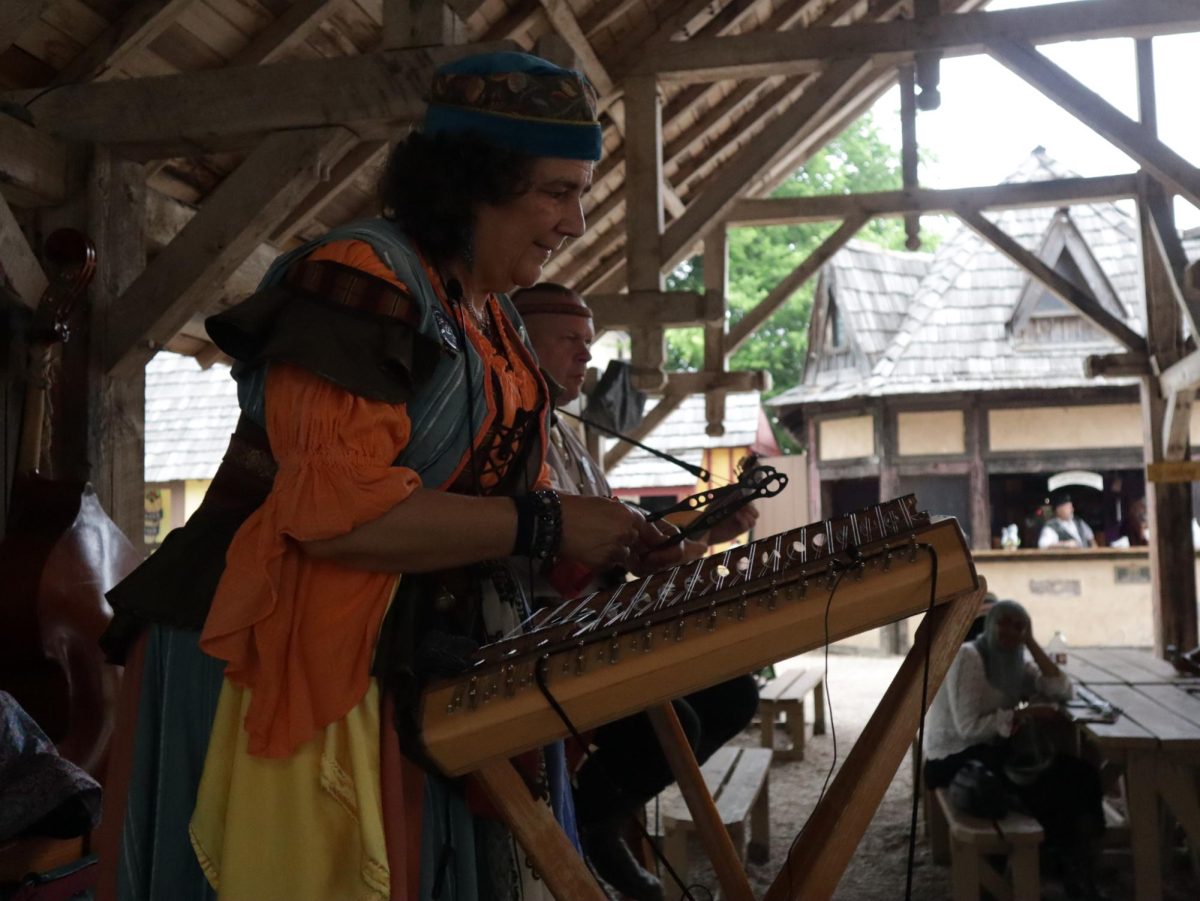
When members of Radio UTD management pulled up in a three-car convoy to the Scarborough Renaissance Festival in Waxahatchie, Texas, our first stop was Hands on Dulcimer, an act put on by Scarborough veteran Rita Callens.
In her twentieth season of Scarborough, Callens has her act down to a science. When the seven of us took our seats inside the King’s Pub, she and her accompanying mandolinist had just begun their set. It was early in the morning, right about 10:30, and a lack of sun from the cloud-clustered sky overhead didn’t stop the humidity from clinging to our skin, frizzing our hair and wigs alike.
After her first song, that was one of the first things Callens said, aside from thank you. “There’s an old joke,” she said. “No one knows how long it takes mandolin players to tune their instruments, not even mandolinists. Which is silly, because I’m the one with a 64-string wood instrument in this humidity.”
(The joke landed extremely well with the Radio UTD crowd.)
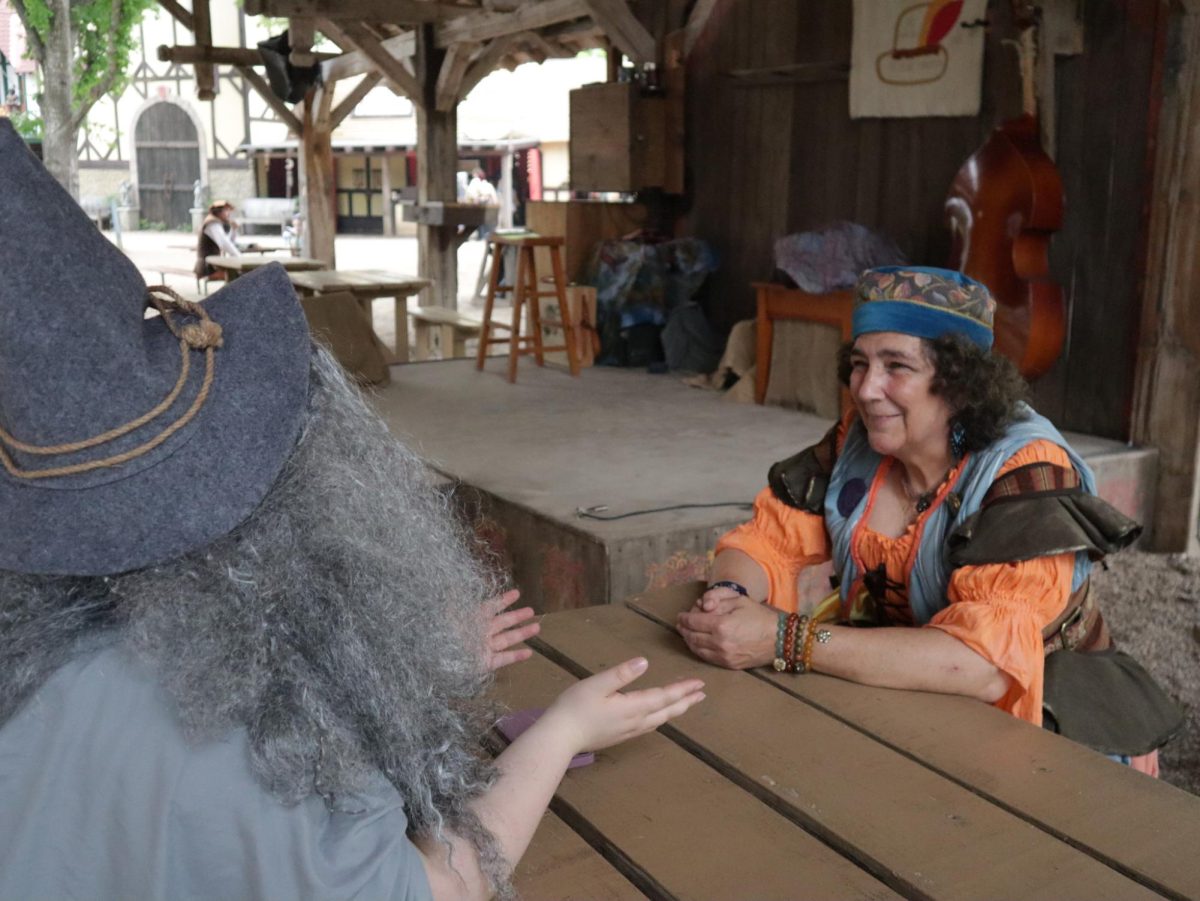
Callens’ entire set was remarkably interactive. I was able to go up and play a tune with her, which, even as someone with years of orchestral pianist experience, was difficult. My massive Gandalf wig and beard didn’t necessarily help (I was like a horse with blinders), but as I hammered away at the two spots Callens had pointed to, I was struck by how impressive her time-keeping abilities are.
The dulcimer echoed with each strike of the wooden hammer, which is surprisingly disorienting when you’re right in front of it. As Callens played next to me, a pattern far more complex than my simple two-note assignment, I found myself struggling to keep time. The notes resounded around us, in step with the mandolin to our left, and I was terrified of losing time and potentially ruining the jig.
For as sloppy as my timing was, Callens played beautifully. I was stuck between keeping my eyes glued to my two strings and trying to catch glimpses of her hammers through the curtain of my wig. Up close, the hammered dulcimer is more complex than one might imagine; while it’s a percussion instrument, not entirely dissimilar to piano or marimba, it differs in construction. Marimbas and pianos, on one hand, are built horizontally and chromatically, representing a full scale and moving up step by step. The hammered dulcimer, with its trapezoidal shape and closely-pegged strings, is diatonic and vertical.
While Callens noted that beginner hammered dulcimer players might label their instrument to keep on track, her instrument was blank. There’s a pattern to playing it, she explained. Different songs have different patterns. It’s these patterns she learns as she adds to her repertoire.
Despite its differences with other percussion instruments, Callens’ love of the hammered dulcimer makes sense. She majored in Vocal Music at Nazareth University, graduating with a BS in Music. During her time there—during which she was required to learn instruments from different families—her favorite classical instrument family was percussion, like the marimba. It makes sense that, from her very first listen, Callens was hooked.
As a long-time hammered dulcimer fan, while I was terrified to play, I was also elated to have the opportunity to play alongside Callens. I wasn’t her only guest player, either; after another song or so, she asked the crowd of little girls (dressed as fairies and princesses, perfect for Scarborough) gathered at the edges of the King’s Pub what kind of song they’d like to hear. Not soon after, Callens asked one of the princesses, dressed as Belle, to join her onstage.
When I sat down with Callens after her set, she told me that the audience participation was one of her favorite parts of playing the hammered dulcimer. Over the years, participation has become such a vital component of her shows that she’s completely engineered them to be crowd events. Interacting with the crowd, playing alongside audience members, introducing people to the hammered dulcimer—they’re a part of the reason she loves the instrument so much.
Still, the hammered dulcimer is heavy, which is unappealing when you have to lug it around the lanes at faires (especially, I’m sure, when they’re as large as Scarborough). For Callens, it also requires tuning at least three times a day, which takes twenty minutes each time. She likes to joke that, in her next life, she’ll play something easier—the flute, perhaps.
“I couldn’t,” she assured me. “I’d miss interacting with the audience.”
One of her favorite parts of any set is having her younger audience members come up, like our Belle. Sometimes they’re scared, she explained, especially when you just hand them a hammer, point, and say, “Hey, play there.” She’ll invite parents up to lend a hand—definitely not something you can do with a flute.
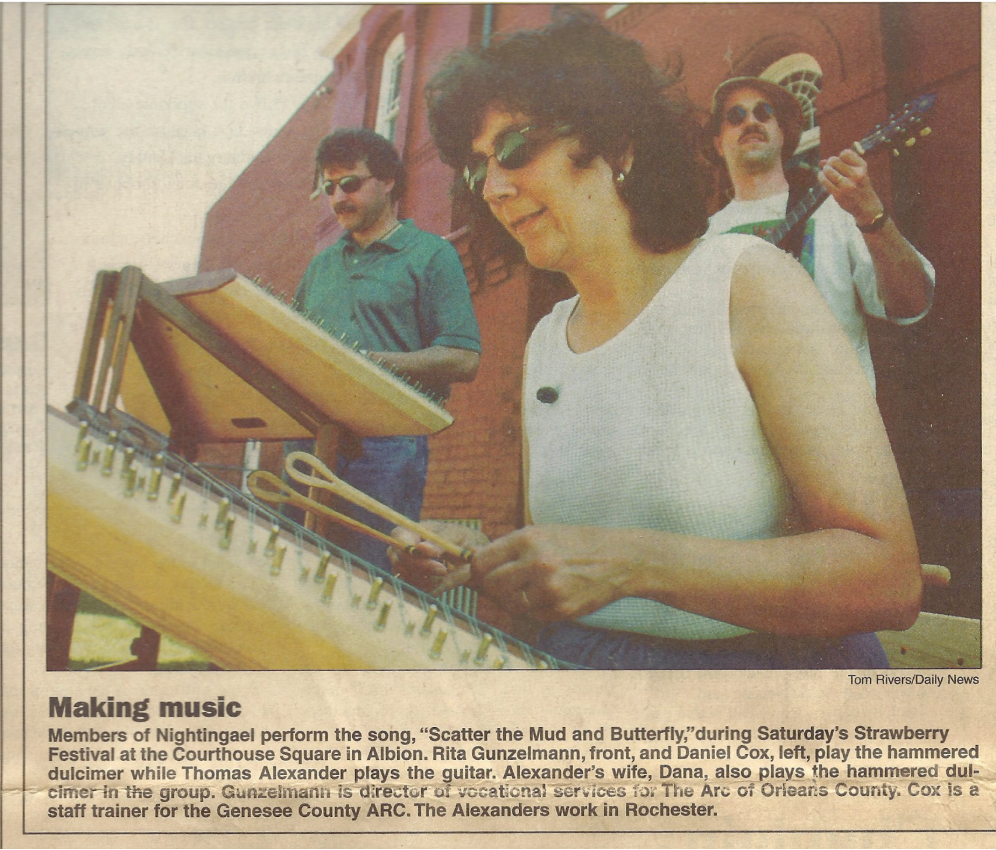
It was at a ren faire in her native New York that Rita Callens first heard the hammered dulcimer. Immediately, she knew she had to play. She joined a local club, something she says plenty of cities have, where she and fellow club members learned one or two tunes a month. Eventually, she says, you get bored with just one or two. You’re eager to learn more. For Callens, this led her and a few other dulcimer students to form NightinGael.
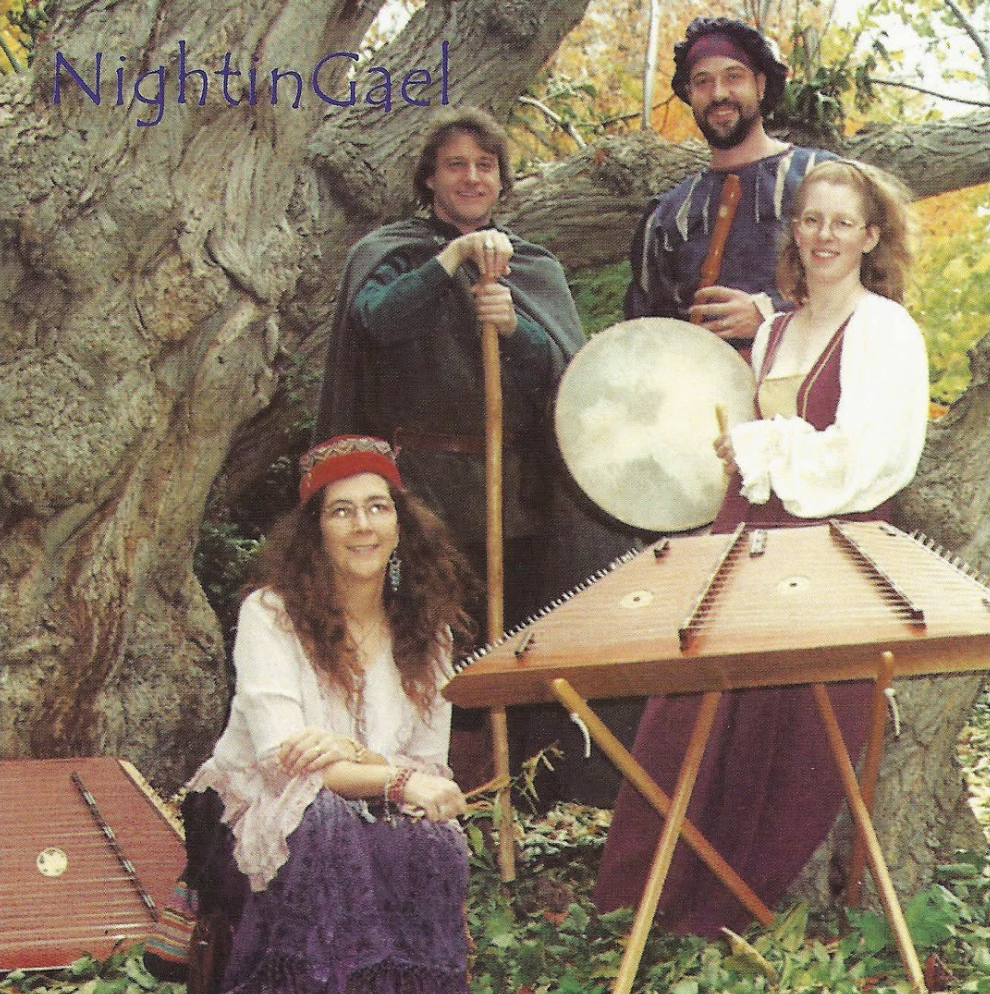
NightinGael, founded by Callens, Dan Cox, and Dana and Thomas Alexander, and based out of Rochester, New York, has existed for over two decades, with their first album, First Flight, coming out in 2003. Callens herself is credited with guitar, shaker, and vocals on top of the hammered dulcimer, which makes plenty of sense, as Callens is nothing if not musical. Her own composition is included in NightinGael’s album, in fact: “Planxty Maureen,” or Ode to Maureen, which is dedicated to her high school music teacher.
Bits and pieces from her live performance can be found across Callens’ releases. Exactly ten years ago, Callens released her solo album, Simple Gifts, which features a collection of some of her tracks (and some that we heard during her performance, including the titular “Simple Gifts”). She actually ended her set with one of her favorite tracks, “March Of St. Timothy,” which is the opening track on First Flight. (It’s the “Woooo, we’re married!” song.)
Callens doesn’t have any favorite styles or vibes of music—it depends on what mood you happen to catch her in, she says. Still, she loves the “Wooo, we’re married!” song, and she loves playing with others. For example, beyond NightinGael and her accompanying mandolin we saw last Saturday, she’s played with Jim Hancock the Burly Minstrel, a Scarborough staple, as well as bagpipes in the past. Bagpipes were especially interesting, according to Callens, because they have to be mic’ed down, while the dulcimer has to be mic’ed up.
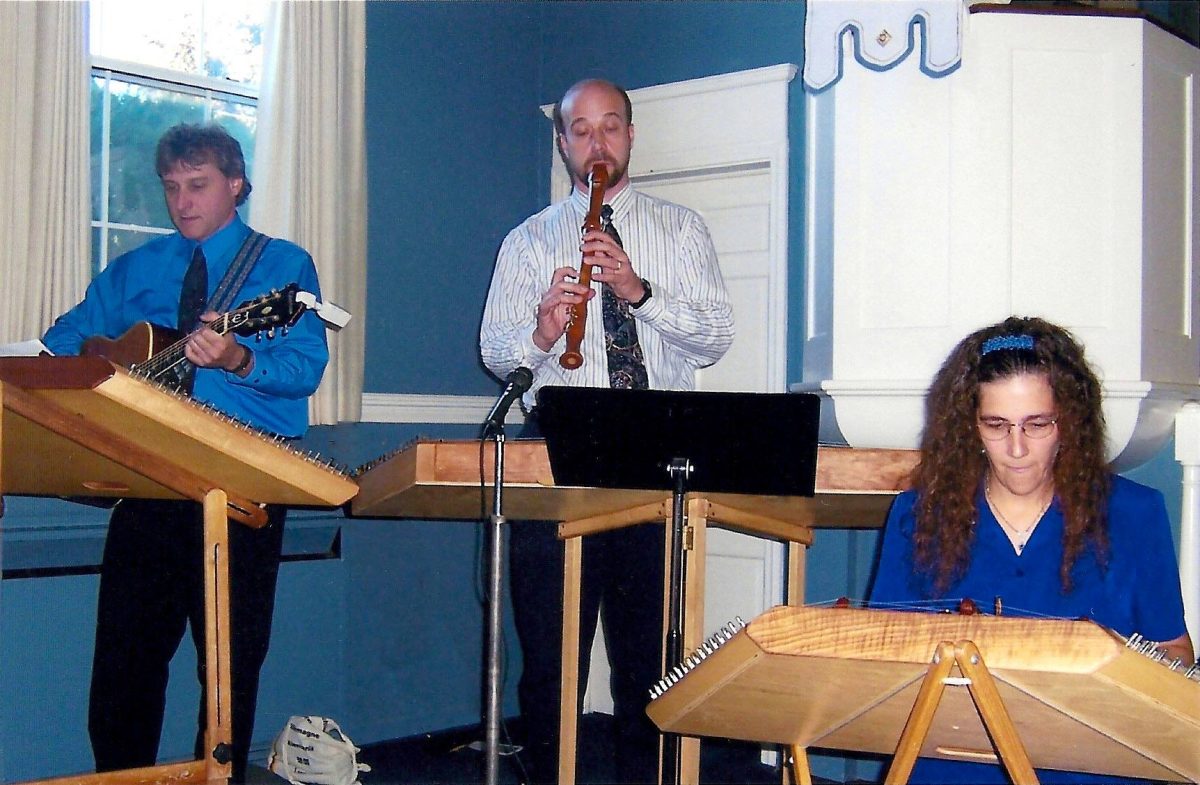
With twenty years at Scarborough under her belt, Callens is herself a Scarborough staple. With her well-thought-out act—her robust repertoire, her audience participation, and her simultaneously soothing and entertaining commentary—Callens is a long-standing talent, one who has seemingly carved out her own space within the Scarborough community and, undoubtedly, will continue to engage crowds for years to come. I know I speak for all of my Radio UTD peers when I say that she was a joy to see, and I can’t wait to listen to her next time I stop by Scarborough.
Interested in hearing more of Rita’s music? Find her Discogs here.
The Scarborough Renaissance Festival will run through May 25, 2026. You can find their schedule, acts, and more on their website or, if you know exactly when you’d like to go, you can buy tickets here.